Understanding Water Damage Categories 1, 2, and 3 in Pflugerville
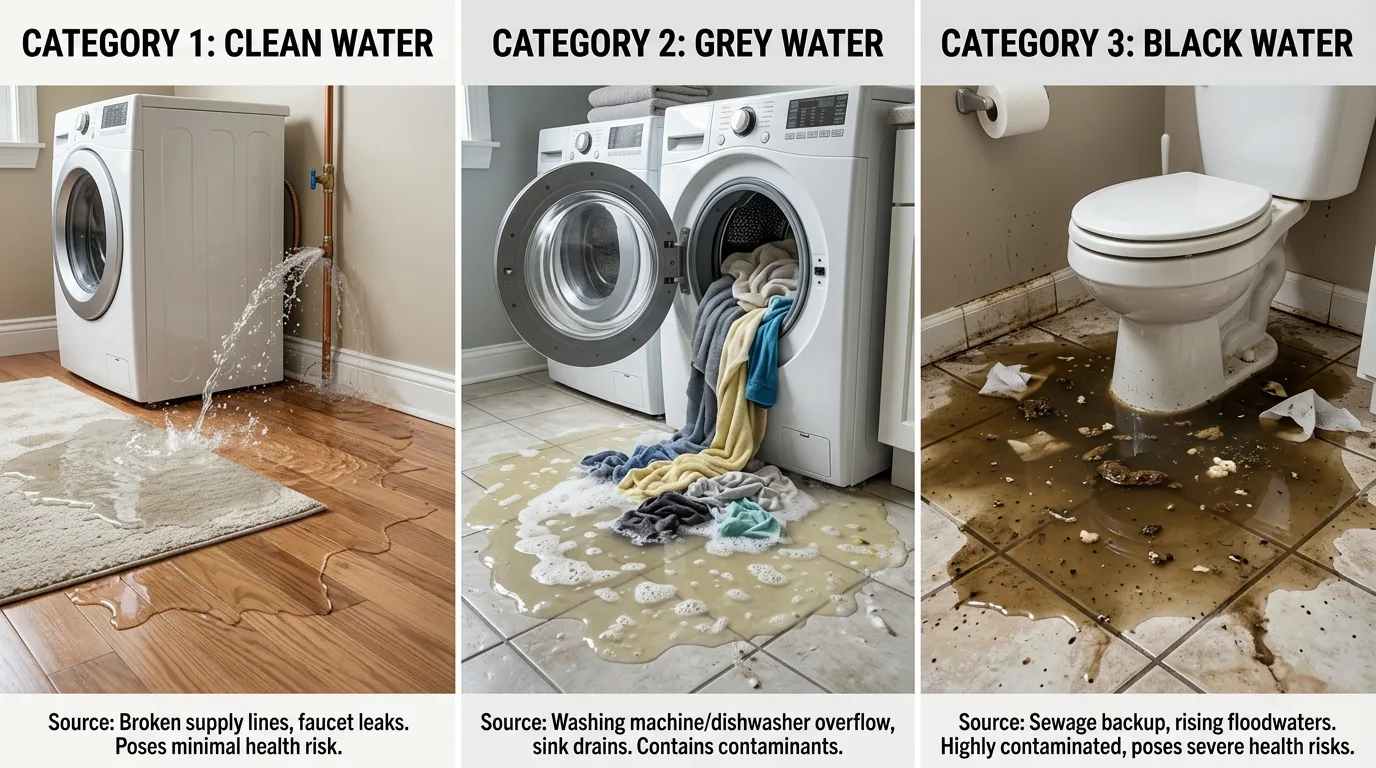
When a restoration professional tells you that your Pflugerville home has Category 3 water damage, they’re not describing severity in the way you might think — they’re describing contamination level. The IICRC S500 water damage standard defines three categories of water that determine every aspect of how restoration is performed: what equipment is used, what personal protective equipment is required, which materials can be dried in place versus removed, and ultimately what the project costs. Understanding these categories helps you make informed decisions after a water emergency.
Not Sure What Category Your Water Damage Is?
Our IICRC certified team provides professional water damage assessment throughout Pflugerville and Travis County. Call (877) 698-1311.
Why Water Damage Categories Matter
The category system exists because water from different sources carries different contamination loads. Water from a clean supply pipe is safe to handle without special precautions. Water from a sewage backup or a flood that has contacted municipal drainage infrastructure carries pathogens that cause serious illness. Treating both with the same protocols either over-responds (adding unnecessary cost to a clean-water event) or under-responds (leaving biohazard contamination in your home’s structure).
Pflugerville’s water damage landscape includes events across all three categories — from clean pipe bursts to Category 3 sewage backups during spring storm system overloads. Knowing the difference helps you understand why your restoration professional is recommending specific protocols and why cost varies significantly between category types.
Category 1: Clean Water
Source: Municipal supply lines (the pipes that bring fresh water into your home), supply line failures on appliances (dishwasher, refrigerator ice maker, washing machine fill hose), intact water heater leaks, and direct rainfall in limited quantities.
Contamination level: None — the water is clean enough to drink at the source. However, Category 1 water can degrade to Category 2 within 24–72 hours if it contacts building materials, is allowed to sit at elevated temperatures, or becomes contaminated by contact with soils or building chemicals.
Restoration approach: Category 1 events are the most straightforward to restore. Affected porous materials (drywall, carpet, wood) can often be dried in place if caught quickly and if moisture hasn’t penetrated to structural levels. No special containment or biohazard protocols are required. Most burst pipe events in Pflugerville’s Blackhawk and Falcon Pointe neighborhoods start as Category 1 events.
In Pflugerville: The majority of residential burst pipe events — including freeze-related pipe bursts during winter storms — start as Category 1. The key variable is response time: a Category 1 event caught within hours stays Category 1. A Category 1 event left for days can degrade to Category 2 as biological growth begins in the warm, humid environment.
Category 2: Gray Water
Source: Washing machine discharge, dishwasher overflow, toilet overflow involving only water (no solid waste), sump pump failure, and aquarium breaks. Also includes Category 1 water that has been contaminated through contact with building materials or prolonged standing at elevated temperatures.
Contamination level: Contains microbiological contamination but at levels that cause illness only with significant exposure. Gray water presents a health risk to people with compromised immune systems and to children and the elderly.
Restoration approach: Category 2 events require greater caution than Category 1. Affected carpet is typically removed rather than dried in place. Technicians use PPE. Antimicrobial treatment is applied to all affected surfaces. The level of material removal depends on the extent of saturation and the specific materials involved. Porous materials with extended exposure to Category 2 water are often treated as Category 3 due to the degradation risk.
In Pflugerville: HVAC condensate overflow events — a common summer occurrence in this climate where air conditioning systems run constantly — often produce Category 2 water. Flooding through window wells or foundation gaps during spring storms can also be Category 2.
Category 3: Black Water
Source: Sewage backups from any source, flooding from external bodies of water (rivers, streams, storm drains), toilet overflow involving solid waste, and any water that has contacted municipal sewage infrastructure. Also includes Category 1 or 2 water that has degraded over extended time in contaminated conditions.
Contamination level: Highly contaminated with pathogens — bacteria including E. coli and salmonella, viruses, and parasites that cause serious and potentially life-threatening illness through direct contact or inhalation of aerosols.
Restoration approach: Category 3 events require full biohazard protocols. All porous materials that have contacted Category 3 water — drywall, insulation, carpet, engineered wood flooring, fabric — must be removed and disposed of under biohazard regulations. They cannot be dried and left in place. Structural components that are non-porous and can be fully disinfected are treated with EPA-registered antimicrobial agents. HEPA air filtration is required during work. Full PPE including respirators, protective suits, and gloves is mandatory for technicians.
In Pflugerville: Spring storm events that overwhelm municipal sewer systems are the most common source of Category 3 events in Pflugerville. When heavy rainfall exceeds the capacity of Pflugerville’s drainage infrastructure, sewage backs up through residential connections — a scenario that the city’s flood risk profile makes more likely than homeowners often realize. The 2021 freeze event produced some Category 3 scenarios when burst pipes in poorly insulated areas discharged near sewer lines.
Sewage Backup or Flood Water in Your Home?
Category 3 events require immediate professional response. Call Pflugerville Water Damage Restoration at (877) 698-1311 — 24/7 emergency dispatch.
How Category Affects Cost in Pflugerville
Pflugerville’s water mitigation average of $2,912–$3,137 (based on 96 projects at $14–$16 per square foot) reflects primarily Category 1 and 2 events. Category 3 events cost more due to:
- Biohazard disposal costs: Materials removed from Category 3 scenes require regulated disposal, not standard trash removal
- Additional labor: Full PPE, slower work pace, and decontamination procedures add technician hours
- Material replacement: Porous materials that could be dried and saved in a Category 1 event must be replaced in a Category 3 event
- Antimicrobial treatment: More extensive than Category 1 treatment requirements
A Category 3 event covering the same square footage as a Category 1 event typically costs 40–70% more due to these factors. Insurance typically covers Category 3 restoration when caused by covered events, but sewage backup coverage is often a separate endorsement — check your policy.
How Categories Can Change During a Project
Water categories don’t always stay constant. Category 1 water that sits in Pflugerville’s summer heat for more than 72 hours can degrade to Category 2. Flood water that enters a Pflugerville home through a foundation crack may start as Category 1 rainwater but become Category 2 or 3 if it passes through soil contamination or contacts municipal drainage. Restoration professionals reassess category throughout the project and adjust protocols accordingly.
This is why the initial assessment and the ongoing professional management of a water damage event matter — category misidentification in either direction creates problems: unnecessary costs if overclassified, serious health risks if underclassified.
Frequently Asked Questions
Can Category 3 damage be cleaned rather than removed?
Not for porous materials — no. Drywall, insulation, carpet, and wood that have absorbed Category 3 water cannot be cleaned to a safe standard because pathogens penetrate deep into porous material where surface disinfectants cannot reach. The IICRC S500 standard and Texas TDLR mold remediation regulations both require physical removal of Category 3 contaminated porous materials. Non-porous materials like metal framing, tile, and concrete can be disinfected in place.
How do I know what category my water damage is?
The source of the water is the primary indicator: burst supply pipe = Category 1, washing machine discharge = Category 2, toilet overflow with waste or sewage backup = Category 3, external flooding = typically Category 2–3 depending on what the water contacted. A professional moisture assessment confirms category and assesses whether degradation has occurred. If you’re uncertain, treat it as the higher category until professional assessment confirms otherwise — it’s safer and protects your household.
Does insurance cover Category 3 cleanup?
Coverage depends on the source of the Category 3 water and your specific policy. Sudden sewage backups from internal plumbing failures are typically covered under standard dwelling coverage. Sewer backup from municipal system overflow may require a separate sewer backup endorsement. External flooding (Category 3 flood water from rivers or storm drains) is typically excluded from standard policies and requires flood insurance. We document the source and category for your adjuster in every case. See our post on homeowners insurance and water damage in Pflugerville for more detail.
Related reading: