The Dangers of DIY Water Damage Cleanup in Pflugerville
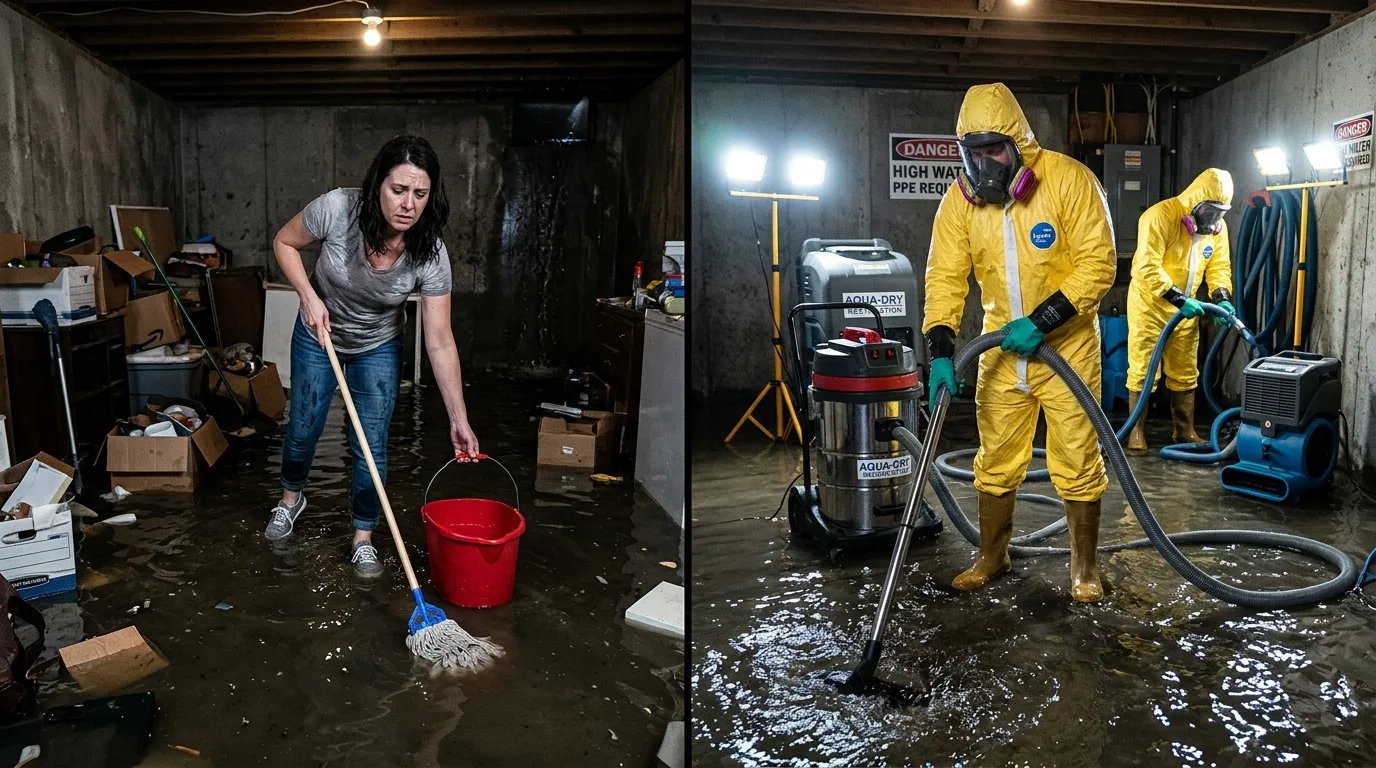
After a burst pipe or flooding event in their Pflugerville home, many homeowners reach for a shop vacuum, a few box fans, and a mop — and believe they’ve handled the cleanup. This instinct to solve the problem immediately and avoid the cost of a professional is understandable. What most homeowners don’t realize is that DIY water damage cleanup in Pflugerville’s climate doesn’t just fall short — it actively creates new problems that are more expensive than the original event. This post covers the specific risks of DIY water damage cleanup in Central Texas and what professionals do differently.
Leave Water Damage Cleanup to the Professionals in Pflugerville
IICRC certified extraction and structural drying protects your home and your insurance claim. Call (877) 698-1311 — 24/7.
Risk 1: Hidden Moisture Becomes Hidden Mold
The most dangerous gap in DIY water damage cleanup is the inability to detect or address moisture inside wall cavities, under flooring, and in structural assemblies. A shop vacuum removes visible standing water from floor surfaces. It does nothing for the water that migrated into drywall core material, wicked up wall framing, or penetrated under engineered hardwood flooring in the first hour after the event.
In Pflugerville’s warm, humid climate, mold can establish on wet building materials in 24–48 hours during summer months. A homeowner who successfully cleans up visible water using consumer tools often returns to find mold odor appearing 2–4 weeks later — the visible manifestation of mold that established in the wet wall cavity that appeared dry from the outside. By this point, what would have been a $3,000 drying project has become a $6,000–$10,000 combined project requiring TDLR licensed mold remediation in addition to the original structural drying.
The thermal imaging cameras and calibrated moisture meters that professional restoration teams use are not optional tools — they’re the only way to confirm that moisture is fully removed from structural assemblies. Consumer tools simply don’t provide this information.
Risk 2: Spreading Moisture to Previously Dry Areas
Running box fans in a wet space without simultaneously running commercial dehumidification is worse than doing nothing. Box fans move air — which carries moisture vapor from wet surfaces to dry ones. In Pflugerville’s summer humidity, where outdoor air can carry 70%+ relative humidity, running fans near open windows or doors can actually add moisture to the affected space. Even in lower-humidity conditions, fans without dehumidifiers spread moisture-laden air throughout the home, extending the zone of saturation to previously dry rooms.
Commercial structural drying works as a system: air movers create rapid airflow across wet surfaces to move moisture vapor into the air, while simultaneous commercial dehumidification removes that vapor before it re-deposits elsewhere. Without both components running together, the physics don’t work in the homeowner’s favor.
Risk 3: Insurance Claim Complications
Homeowner insurance policies require that policyholders take reasonable steps to mitigate damage after a covered event. Attempting DIY cleanup — and doing it incompletely — creates several insurance problems:
Inadequate documentation: Insurance adjusters require calibrated moisture readings, equipment deployment records, and daily monitoring logs to authorize claim scope. A homeowner’s description of “I used fans for a week” doesn’t satisfy these requirements. Without professional documentation, adjusters may question whether the claimed scope of damage is accurate or whether some damage resulted from the incomplete DIY attempt rather than the original covered event.
Delayed discovery of full scope: When DIY cleanup masks the visible signs of water damage (surface drying) without addressing hidden moisture, the full damage scope often isn’t discovered until mold appears weeks later. Insurance carriers may dispute covering mold that developed because the original water damage wasn’t professionally remediated promptly.
Permit compliance questions: Travis County requires permits for repairs to flood-damaged structures with a contractor-prepared line-item estimate. DIY repair work that doesn’t meet permit requirements can complicate property sales and insurance claims.
Protect Your Claim — Call a Professional First
Pflugerville Water Damage Restoration provides complete documentation for insurance claims. Call (877) 698-1311 for 24/7 response.
Risk 4: Health Exposure From Category 2 and 3 Water
Not all water damage cleanup is safe for unprotected homeowners. Water from a toilet overflow, a sewage backup, or flooding that has contacted municipal drainage infrastructure is Category 2 or 3 contaminated water — containing bacteria, viruses, and parasites that cause serious illness through direct contact and inhalation.
DIY cleaning of Category 3 sewage events with bleach and mops exposes homeowners to concentrated pathogens without the respirators, protective suits, and HEPA air filtration that professional biohazard protocols require. Bleach kills surface bacteria on non-porous surfaces but is ineffective at penetrating porous materials like drywall and subfloor assemblies where pathogens live. The result of DIY Category 3 cleanup is often a home that appears clean but retains dangerous contamination in building materials — a health risk that persists for the occupants.
Risk 5: Incomplete Drying Leads to Structural Damage
Wood framing that stays wet above 19% moisture content for extended periods develops structural degradation. Subfloor OSB that remains saturated will delaminate, becoming unsuitable for flooring reinstallation regardless of how long it subsequently dries. Drywall that dries slowly in a poorly controlled environment often dries unevenly — pulling away from framing, developing surface irregularities, and retaining moisture in interior paper layers even when the surface feels dry.
DIY drying that takes 2–3 weeks using consumer fans reaches the same endpoint that professional structural drying reaches in 4–7 days — but at much higher risk of the secondary damage that develops from extended wet time. The professional timeline isn’t just faster; it substantially reduces the scope of reconstruction required because materials are dried before degradation thresholds are reached.
What Professional Restoration Does Differently
The core difference is that professional water damage restoration in Pflugerville produces measurable, documented results rather than visual impressions:
- Thermal imaging identifies ALL moisture, not just visible water
- Calibrated moisture meters confirm dryness by measurement, not feel
- Commercial equipment scales drying rate to the damage scope
- Daily monitoring adjusts the drying plan based on actual readings
- Final drying certification provides documented evidence of completion
- Insurance documentation supports claim authorization at every stage
This isn’t just better than DIY — it’s categorically different. See our complete 8-step process for what professional restoration looks like from start to finish.
When Homeowners Can Help
There are specific things homeowners can and should do before professional restoration arrives that are genuinely helpful:
- Shut off the water main to stop the source
- Take photos and video before touching anything
- Move undamaged portable items out of the wet area
- Call insurance and report the loss the same day
- Keep children and pets out of the affected area if sewage is involved
Mopping up surface water, removing wet rugs, and blotting furniture are reasonable immediate actions for Category 1 (clean water) events. These actions limit further spread while the professional crew arrives. They are not substitutes for professional extraction and structural drying — they are first steps that buy time.
Frequently Asked Questions
What if the water event was small — do I still need a professional?
The question isn’t the size of the visible event — it’s whether moisture has penetrated building assemblies. A small amount of water from a refrigerator line that sat overnight can saturate subfloor material and wall base cavities far beyond the visible wet area. A professional moisture assessment — which takes less than an hour — provides a definitive answer. The cost of the assessment is far less than the cost of mold remediation that results from assuming a small event was self-contained.
Can I use a consumer dehumidifier to dry my home after water damage?
Consumer dehumidifiers (25–50 pint per day units) are designed for humidity control in already-dry spaces, not for structural drying after water intrusion events. They cannot achieve the moisture removal rate needed to dry structural building materials to acceptable levels within the mold prevention window. Running a consumer dehumidifier after a water event may reduce visible condensation without addressing structural saturation at all. It also doesn’t produce the documentation that insurance claims require.
What about videos I’ve seen of homeowners drying out their own floors after flooding?
DIY floor drying can appear successful — the visible surface dries. What you can’t see from the video is whether the subfloor, framing, and wall base cavity moisture also reached acceptable levels, or whether mold established in those areas while the visible surface looked good. The outcome of DIY drying in Pflugerville’s climate is often mold discovered 3–6 weeks later in exactly the areas that weren’t verifiably dried by calibrated equipment.
Related reading: