7 Types of Water Damage Restoration Equipment We Use in Pflugerville
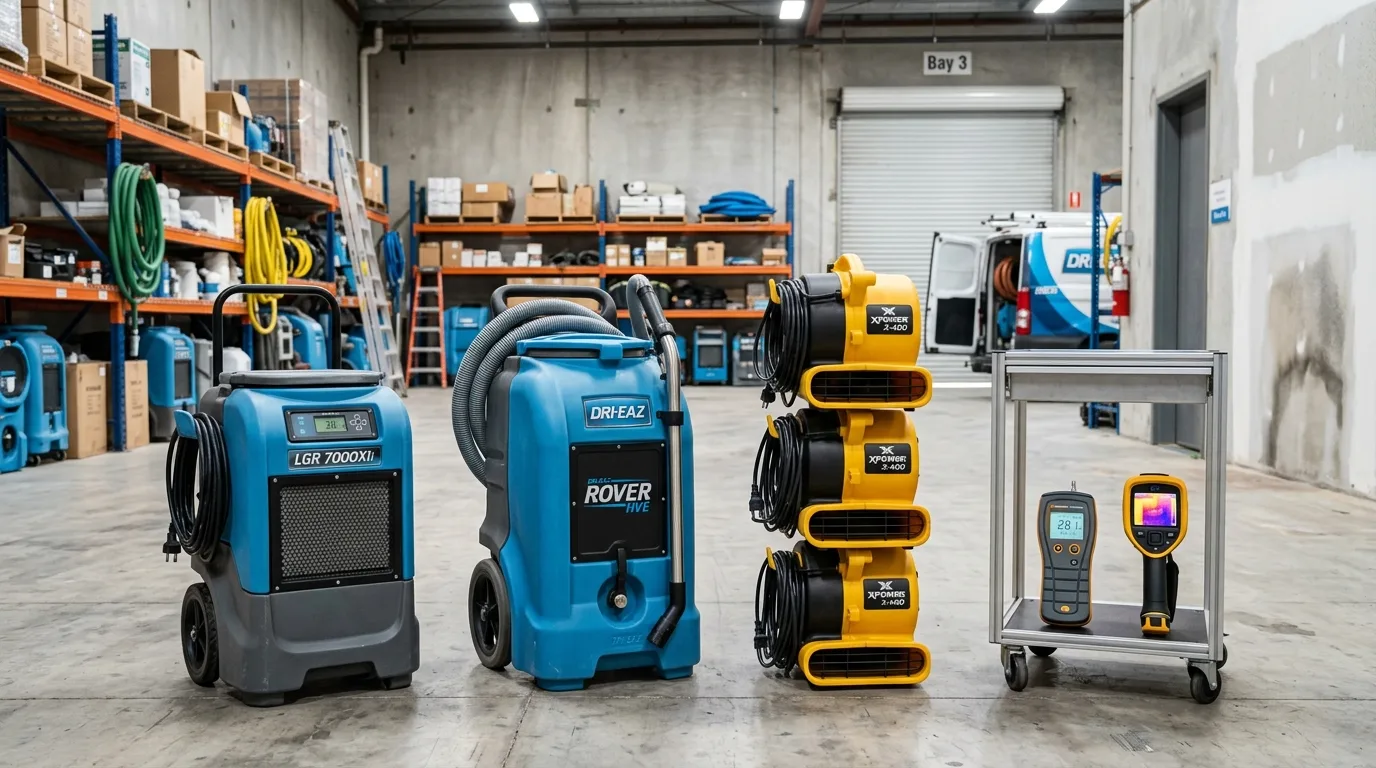
One of the most common questions Pflugerville homeowners ask after a water damage event is: “Why can’t I just rent some fans and dry this myself?” The answer lies in understanding what professional water damage restoration equipment actually does — and why consumer alternatives fall so far short that they can make the problem worse. This post covers the 7 types of equipment that IICRC certified restoration professionals deploy, why each one matters, and what the difference looks like in practice for a Pflugerville property.
Pflugerville Water Damage? Professional Equipment Makes the Difference
Industrial extraction and drying equipment, daily moisture monitoring, and insurance documentation. Call (877) 698-1311 — 24/7.
Why Equipment Matters in Water Damage Restoration
Professional restoration equipment isn’t just a higher-powered version of consumer tools — it operates on different principles designed for structural drying science. Residential fans, for example, move air but don’t control humidity. Without simultaneous dehumidification, fans spread moisture-laden air from wet surfaces to dry surfaces, potentially extending the moisture migration rather than removing it. In Pflugerville’s summer months — when outdoor relative humidity can exceed 75% — running fans without dehumidification actively works against drying.
The IICRC S500 standard for water damage restoration specifies equipment performance requirements precisely because the tools matter as much as the technique.
Equipment Type 1: Truck-Mounted Water Extractors
Truck-mounted extraction units generate 10–15 times more suction than portable shop vacuums. Mounted on a service vehicle with a separate power source, these units use high-velocity water lift to extract standing water from floors and — with specialized attachments — from wall cavities, subfloors, and upholstery. For Pflugerville homes where clay soil surrounding the foundation holds water in contact with the structure for extended periods, rapid extraction reduces the total saturation time that drives damage cost.
Truck-mounted units are supplemented by portable extraction machines for areas that can’t be reached from outside the structure, and by specialty tools like floor-drying mats that create suction directly against subfloor material surfaces.
Equipment Type 2: Industrial Air Movers
Industrial air movers — sometimes called “snail fans” due to their housing shape — are designed specifically for structural drying. They generate high-velocity airflow at a low angle across wet surfaces, creating boundary-layer disruption that dramatically accelerates moisture evaporation from building materials. A typical residential water damage job in Pflugerville deploys 5–20 air movers depending on the affected area.
The key difference from consumer fans: air movers are designed to be positioned precisely against wet surfaces to maximize the drying effect on specific materials. They are positioned by calculation — based on the cubic footage of the space, the materials present, and the moisture readings — not just “pointed at wet stuff.”
Equipment Type 3: Commercial Dehumidifiers
Commercial refrigerant dehumidifiers remove 80–200+ pints of moisture per day — compared to the 25–50 pints typical of consumer units. In Pflugerville’s humid climate, ambient outdoor humidity often exceeds 70% during summer, which means indoor air replenishes moisture vapor as fast as a small consumer dehumidifier can remove it. Commercial units maintain indoor relative humidity below 40–45% even in high-outdoor-humidity conditions, creating the controlled environment where structural drying proceeds effectively.
Dehumidifiers are the counterpart to air movers in the structural drying system: air movers extract moisture from materials into the air as vapor; dehumidifiers remove that vapor from the air before it re-deposits on dry materials. Both must run simultaneously for effective structural drying.
Equipment Type 4: Thermal Imaging Cameras
Thermal imaging cameras detect temperature differentials that indicate moisture presence behind walls and under flooring. Wet materials are cooler than dry materials — a thermal image shows moisture migration patterns that are completely invisible to the naked eye. In a Pflugerville home where a burst pipe has released water inside a wall cavity, thermal imaging reveals the full extent of moisture spread without requiring any demolition.
This equipment transforms the initial damage assessment from a visual inspection into a data-driven moisture map. Restoration work targeted at the areas thermal imaging identifies is complete; restoration work based only on visual assessment misses the hidden saturation that becomes a mold problem weeks later.
Professional Equipment, Professional Results in Pflugerville
IICRC certified team with industrial extraction, drying, and moisture detection equipment. Call (877) 698-1311 for 24/7 emergency response.
Equipment Type 5: Calibrated Moisture Meters
Moisture meters measure the actual water content of building materials at the point of contact. Different materials have different acceptable moisture content baselines — wood framing should read below 19%, gypsum drywall should be at or near ambient levels. Moisture meters allow restoration professionals to confirm that drying is complete by measurement, not by appearance or feel.
This is the equipment that produces the daily moisture logs that insurance adjusters require to authorize claims. Without documented moisture readings, there is no objective evidence that drying was performed to standard — and no basis for the claim documentation that supports reconstruction authorization. HEPA air scrubbers used during mold remediation and Category 3 sewage cleanup projects are also monitored via particle counters to confirm contamination clearance.
Equipment Type 6: HEPA Air Scrubbers
HEPA (High-Efficiency Particulate Air) scrubbers filter air through a HEPA filter that captures particles 0.3 microns or larger at 99.97% efficiency — including mold spores, bacteria, and fine debris. During mold remediation and Category 3 sewage cleanup projects, air scrubbers run continuously in the work zone to prevent spore and pathogen migration to unaffected areas of the Pflugerville home.
Air scrubbers are particularly important in Pflugerville given the mold risk profile of the local climate. Projects where mold is confirmed or Category 3 water is involved require HEPA filtration as part of the containment system — it’s not optional equipment on these job types.
Equipment Type 7: Desiccant Dehumidifiers
For advanced drying applications — particularly hardwood floor drying and structural drying in cold conditions — desiccant dehumidifiers provide capabilities that refrigerant units can’t match. Desiccant units work by passing air over a moisture-absorbing material (typically silica gel) and releasing the captured moisture to exhaust. They operate effectively at lower temperatures where refrigerant units lose efficiency, and they produce drier air (lower dew point) that enables faster drying of dense materials.
For Pflugerville homes with hardwood flooring that has absorbed moisture from a burst pipe event, desiccant-assisted hardwood floor drying — using specialized mat systems placed directly over the floor surface — can save flooring that would otherwise require replacement, producing significant savings on the insurance claim.
Practical Uses of This Equipment Knowledge
When evaluating a contractor: Ask specifically what equipment will be deployed and whether daily moisture documentation will be provided. A contractor who can’t answer these questions or who uses consumer-grade equipment may produce incomplete drying and hidden mold problems.
When reviewing your insurance scope: If your adjuster’s estimate doesn’t include proper equipment line items, the scope may be undervaluing the professional work required.
When understanding your project: Knowing what each piece of equipment does helps you ask informed questions when our technicians explain daily readings and drying progress at your Pflugerville property.
When assessing completion: Drying is complete when calibrated moisture meter readings reach target levels — not when equipment is removed. Ask for your final drying certificate before reconstruction begins.
Frequently Asked Questions
Can I rent drying equipment myself?
Equipment rental is available, but equipment rental is not the same as professional structural drying. Equipment must be positioned correctly (calculated placement based on the space and materials), monitored daily (readings adjusted based on progress), and run for the full drying period (not removed early). Without IICRC trained technicians managing the process, equipment rental often produces incomplete drying that leads to mold problems. Insurance adjusters also typically require documentation from a certified restorer — a homeowner’s rental receipt does not satisfy claim documentation requirements.
How do I know if dehumidifiers are actually working in my Pflugerville home?
A working dehumidifier fills its reservoir or discharges continuously through a drain line. You can also measure indoor relative humidity with a consumer hygrometer ($15 at hardware stores) — properly functioning commercial dehumidification should drive indoor RH below 45–50% in the affected area. Our technicians record RH at each monitoring visit as part of the daily log, giving you an objective record of drying progress.
Does professional equipment make a cost difference in Pflugerville?
Yes — the efficiency of industrial equipment compared to consumer tools typically means shorter drying time (fewer days of equipment rental cost), more complete drying (lower likelihood of mold and reconstruction cost), and complete documentation (cleaner insurance claim). The cost of professional equipment is built into the restoration estimate and is typically covered by insurance as part of the claim. Attempting to DIY with rental equipment often results in extended timelines, incomplete drying, and out-of-pocket mold remediation costs that insurance won’t cover because the DIY approach wasn’t documented to standard.
Related reading: